Making Clear Requests
Vague In, Vague Out
The single most important thing about working with AI: the quality of what you get back depends on the quality of what you put in. A vague prompt gets a vague response. A specific prompt gets a focused, useful one.
And unlike a human colleague, AI won't ask you clarifying questions when your request is ambiguous — it will just guess what you meant and give you something. That something might be exactly what you needed, or it might be completely off base. The gap between those outcomes usually comes down to three elements.
The Three Pillars of a Good Prompt
Every effective prompt has three elements — Scope, Intent, and Structure:
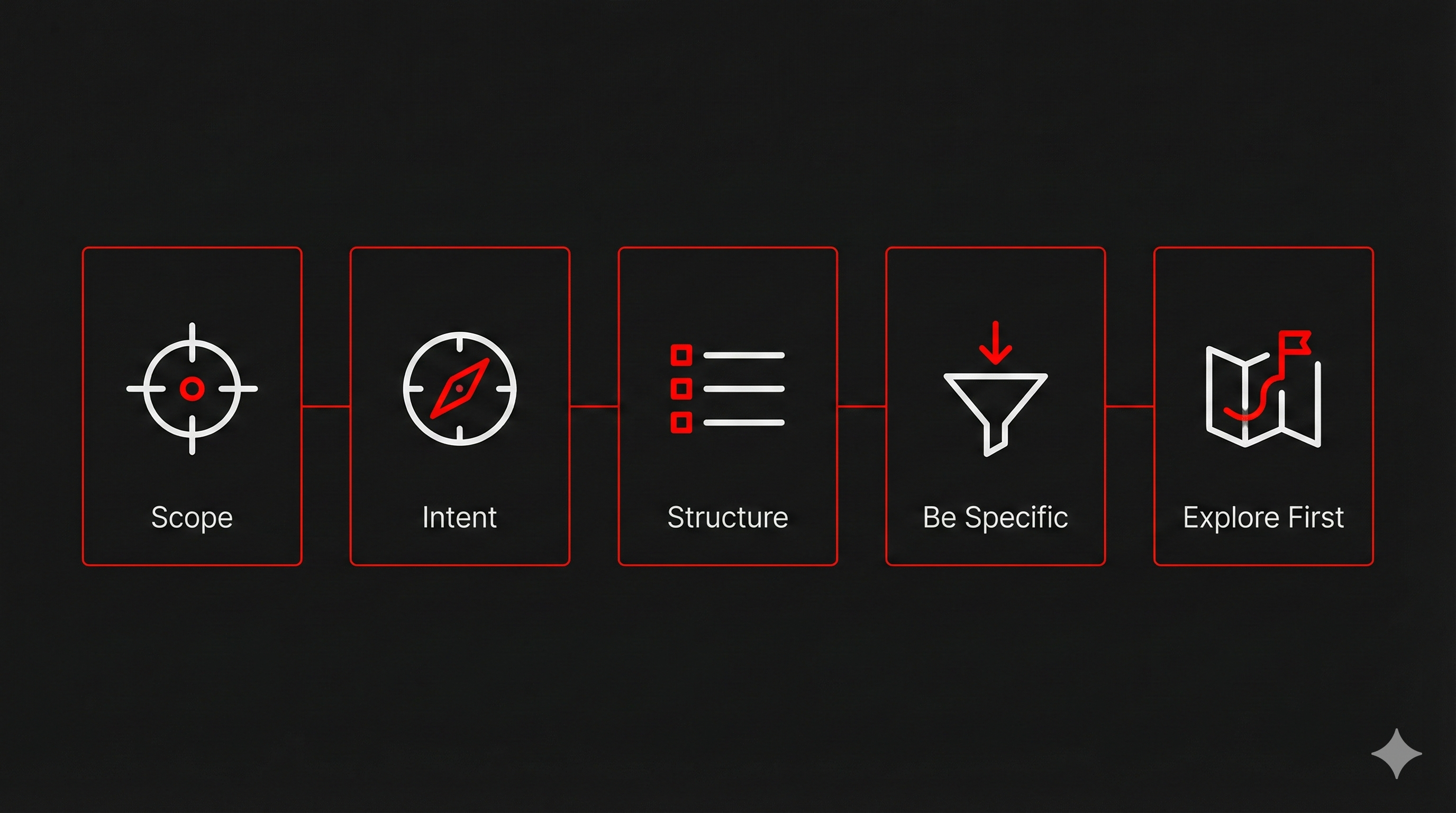
Scope: What are you asking for?
Define the boundaries. What's included, what's not. A prompt without scope is like telling a colleague "handle the project" — technically actionable, but you'll get something you didn't expect.
Vague: "Build me an avalanche app" Scoped: "Add a form that collects avalanche observation reports with fields for date, location, observation type, and description"
Intent: What's it for?
Tell AI why you want it. Intent changes everything. "Build a data display" could mean a table, a chart, a dashboard, or a raw data dump. "Build a data display so backcountry skiers can quickly assess danger at a glance" narrows the possibilities dramatically.
Structure: What format should it take?
Tell AI how to organize its output. Want a list? Say so. Want code in a specific framework? Specify it. Want a comparison? Ask for pros and cons. Structure eliminates an entire category of "not what I meant."
Why Specificity Works
Think of words as having neighborhoods of related meanings. When you say "build a display," AI considers all the possibilities — a table, a chart, a dashboard, a raw data dump. It has to guess which neighborhood you mean. When you say "build a sortable table displaying avalanche observations with columns for date, zone, and type," you've narrowed it to one neighborhood.
The pattern: specificity narrows what AI considers. AI has millions of possible responses to any prompt. A vague prompt leaves that space wide open — AI picks from a vast set of "reasonable" answers. A specific prompt narrows the set to options that are consistently useful.
You don't need to write more words — you need to write more specific words. Every specific word in your prompt narrows the range of possible outputs. That's what the pillars do: Scope narrows where, Intent narrows what, and Structure narrows how.
This is also why the same vague prompt gives you wildly different results each time (probabilistic + unconstrained = maximum variation), but a specific prompt produces results that are reliably close to what you need — even though they're never identical.
Try It: Vague vs. Specific
Format: Split & Compare Time: ~3 minutes Setup: Split your team into two pairs.
Pair A — Open your AI coding assistant and send this prompt:
Help me build an observation form
Pair B — Send this prompt instead:
Add an HTML form for submitting avalanche field observations. The form needs: date (date picker), location (text input for zone name), observation type (dropdown with options: snowpack, avalanche, weather, red flag), and a description (textarea, max 500 characters). Include a Submit button.
Run claude in your terminal and paste the prompt directly.
Run codex in your terminal and paste the prompt directly.
Open pi.dev in your terminal and paste the prompt directly.
Regroup: Compare what each pair got. How different were the results? Which pair got something closer to what you'd actually want to ship? That gap is the power of the three pillars.
Clean up: This was just an experiment — you don't want these changes in your project. Tell your AI coding assistant:
Undo everything you just changed — that was just an experiment.
Key Insight
The three pillars — Scope, Intent, Structure — aren't about writing more words. They're about writing more specific words. Every specific word narrows the possible outputs. When your results aren't what you expected, check: did you give AI all three? Next, you'll learn a format that delivers all three pillars every time.