The Skill That Changes Everything
Vague In, Vague Out
Here's the single most important thing about working with AI: the quality of what you get back depends on the quality of what you put in.
If you ask a colleague "tell me about the project," you'll get a rambling answer — because they don't know what you actually need. The same thing happens with AI. A vague prompt gets a vague response. A specific prompt gets a focused, useful one.
This isn't a flaw in AI. It's how communication works. The difference is that AI won't ask you clarifying questions the way a human would — it will just guess what you meant and give you something. That something might be brilliant, or it might be completely off base.
The skill you're building right now is prompting — giving AI clear, specific instructions so you get what you actually want, not what it guesses you want.
The Three Pillars of a Good Prompt
Every effective prompt has three elements. We call them Scope, Intent, and Structure:
| Pillar | What It Means | Example |
|---|---|---|
| Scope | Where should AI focus? What should it look at? | "Using the avalanche danger scale..." |
| Intent | What action do you want? Create? Summarize? Compare? | "...create an interactive HTML page..." |
| Structure | How should the output be organized? | "...with a color-coded scale from 1 to 5, a description for each level, and travel advice." |
Without these pillars:
Make me something about avalanche safety
AI guesses what to focus on, what to create, and how to organize it. You might get a paragraph of text. Or a quiz. Or a poster design. Who knows.
With all three pillars:
Create an interactive HTML page that shows the 5-level avalanche danger scale. For each level, show the danger name, a color-coded indicator (green through black), and the official travel advice. Make it mobile-friendly.
Same topic. Completely different result.
Why Specificity Works
Think of words as having neighborhoods of related meanings. When you say "service," AI considers all the meanings — military service, food service, customer service, tech services. It has to guess which neighborhood you mean.
When you say "customer onboarding service," you've narrowed it to one neighborhood. No guessing needed.
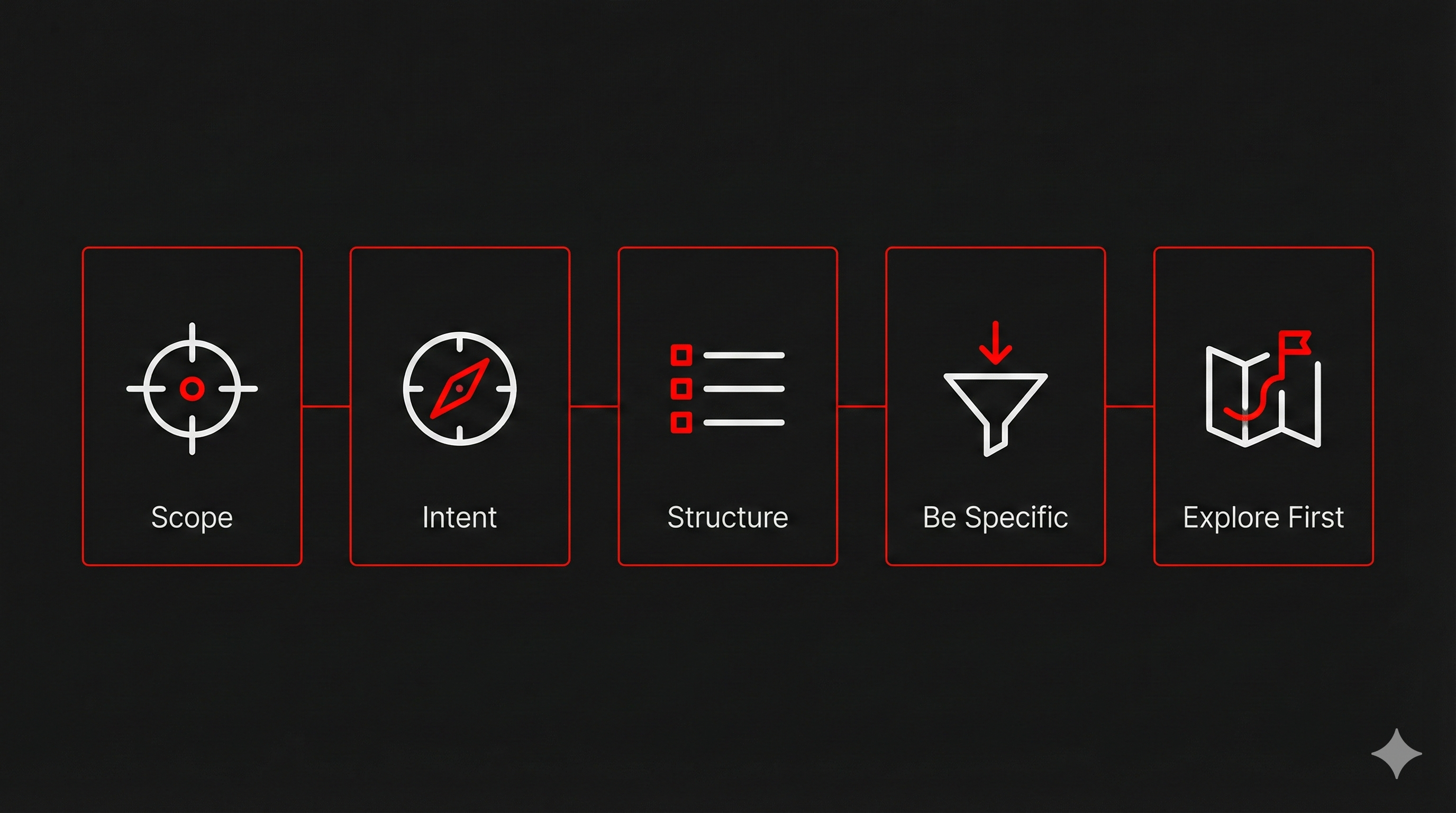
You don't need to write more words — you need to write more specific words. Every specific word in your prompt narrows the range of possible outputs. That's what the pillars do: Scope narrows where, Intent narrows what, and Structure narrows how.
Try It: The Contrast Experiment
Time to prove this to yourself. Start a new conversation in your AI chat tool and try both of these prompts — one vague, one specific. (Use a new conversation for each prompt.)
Prompt A (vague):
Tell me about avalanche safety
Prompt B (specific):
Create a one-page HTML checklist that backcountry skiers can use before heading out. Include: current conditions to check, gear to verify, three decision-making questions (should I go? should I change my route? should I turn back?), and an emergency contact section. Make it visually clean with clear headings.
Look at the difference. Prompt A gives you general information. Prompt B gives you something you could actually use.
Go to claude.ai and paste each prompt into a new conversation. For Prompt B, Claude will generate a full HTML page — click the preview to see the rendered result.
Go to chatgpt.com and paste each prompt into a new chat. For Prompt B, ChatGPT will generate HTML — you can copy it into a browser to see the result.
Key Insight
Every word in your prompt narrows the possible outputs. The Three Pillars — Scope, Intent, Structure — are the principle behind why specificity works. Next, you'll learn a format that delivers all three pillars every time — so you don't have to think about them individually.